
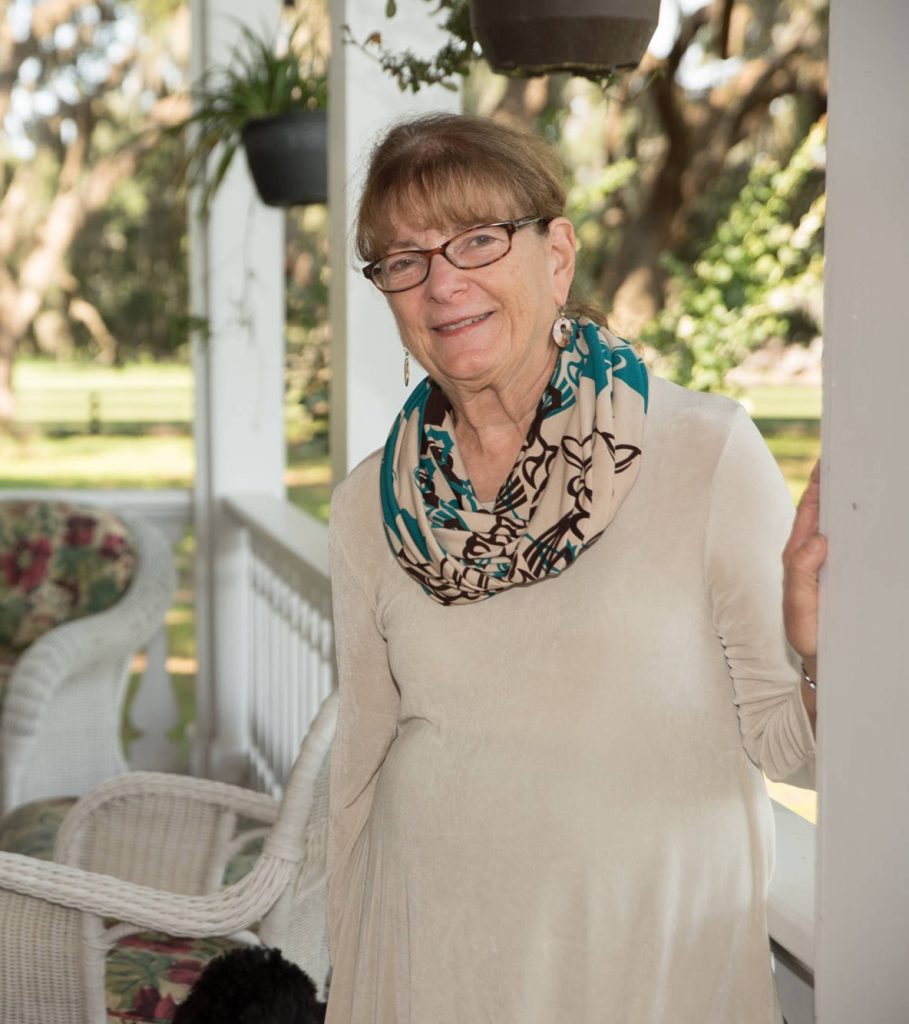
A Hands-On Preservationist
Working to establish historic preservation organizations is Jean Bunch’s forte. Bunch began her involvement with the Florida Trust soon after our 1978 incorporation; she served on the Board of Directors from 1981 – 1990. Bunch recalled there were many things the new organization had to figure out from scratch. Her work focused on bringing into the fold a historic estate that had been gifted to the Florida Trust. “I applaud the Florida Trust for staying strong with a big role to play in the preservation of Florida as the state is growing by leaps and bounds,” she said. “It is ever more important to stay the course.” Bunch paraphrased John Ruskin who inspired the National Trust founding when she said: future generations will judge us by what we built as by what we tear down.
It was antiques that led Bunch to the historic preservation movement. She was an Antique Collectors Club member in Lakeland, Florida. The several clubs in the area met together for presentations. The Florida Trust’s first president Joan Jennewein came to speak to the gathered clubs about the newly formed nonprofit, showing the National Trust’s 6mm film, A Place In Time,to educate the group on historic preservation. Bunch was inspired.
She turned right around and helped establish Historic Lakeland, Inc. as a founding member in 1979 and is still serving as a board member today. At HLI’s inception, Bunch bought a copy of that National Trust film A Place in Time and “hauled it around” garnering support for this new organization.
Bunch came to historic preservation honestly, having just restored her family’s 1914 farmhouse. She literally joined the carpenter’s crew and stood at a bandsaw cutting out each baluster for the open front porch the restoration called for. The contractor explained how cost prohibitive it would be for his crew to undertake the project. Bunch stepped up. The contractor took her under his wing and taught her to operate the different equipment. She was a hands-on participant in the farmhouse restoration. Of all the historic preservation projects that followed, the well lived in farmhouse home remains her favorite. It has provided all the room her family of five needed to grow on their cattle ranch outside Lakeland.
A major HLI project close to Bunch’s heart was the Frances Langford Promenade along Mirror Lake. This park was formalized in the late ’20s and is a Lakeland landmark. By the ’70s it was in terrible condition. “ Lakeland had lost track of its history,” Bunch said.
The park was designed by Charles Wellford Leavitt, who admonished the city to never put a road along the lake’s south shore because it would break up the promenade. But in the ’50s the City did exactly that. It was no longer used as a park because traffic made it so difficult to get across to the lake. Lampposts were falling into the water and weeds were growing in between the flagstones, Bunch recalled the park needed help.
The promenade was inspired by the 1894 Colombian Exposition. Singer and actress Frances Langford was Lakeland’s hometown sweetheart. She traveled with Bob Hope throughout WWII entertaining the troops. When she returned home to Lakeland in 1947 the City dedicated the park to her. There was just one single sign and as the park fell into neglect, Frances Lanford’s story was lost. A Lakeland native who returned home resurrected this history.
Based on influential American architect and urban planner Daniel Burnham’s quote, “Make no little plans,” HLI undertook a restoration campaign of the same name, raising dollars for the research necessary to nominate the Frances Langford Promenade to the National Register of Historic Places in 1983.
Historic Lakeland secured state grants for the restoration. The City, though resistant at first, bought in and closed the road that had divided the promenade. After many fundraising events and programs plus advocacy in the state’s capital, the project took wing. The City of Lakeland took over the restoration efforts in 1986. The promenade is now a show case and the park boasts an appropriate plaque with a picture of Frances at the original dedication ceremony.
Historic Lakeland had the pulse of the community. Downtown was the endangered New Florida Hotel. The city couldn’t lose this landmark – it was part of the skyline. Original construction started in the late ’20s only to be halted by the 1929 Great Crash and the building was finished in the ’30s. There was intense pressure to demolish the building. A city council candidate even suggested inviting a Hollywood movie company to come in and film the building imploding to make way for development. But Historic Lakeland decided to save it and at nine stories tall, the hotel still serves as a special part of Lakeland’s downtown skyline.
“Historic preservation is such an important component of a community. It builds community pride”, said Bunch. “It let’s us know where we came from, where we’re going and why it is important.”
Husband David has been a part of her preservation successes. He bought into all her projects and she his. They are a team with shared historic preservation interests who are supportive of one another.
Former Lakeland Mayor Bill Mutz said Bunch commented to a Chamber of Commerce Leadership Lakeland class, “There’s no right way to do a wrong thing’ . . .it epitomizes how they work and live.”
Additionally, the Bunches restored a 1909 house in downtown that served as David’s real estate business office from 2007-2025 until someone walked in off the street and offered to buy it. With David now working from a historic barn on their property, Bunch’s plans for the future are focused on more yard work while enjoying her favorite historic preservation project – the 1914 farmhouse that started it all.